
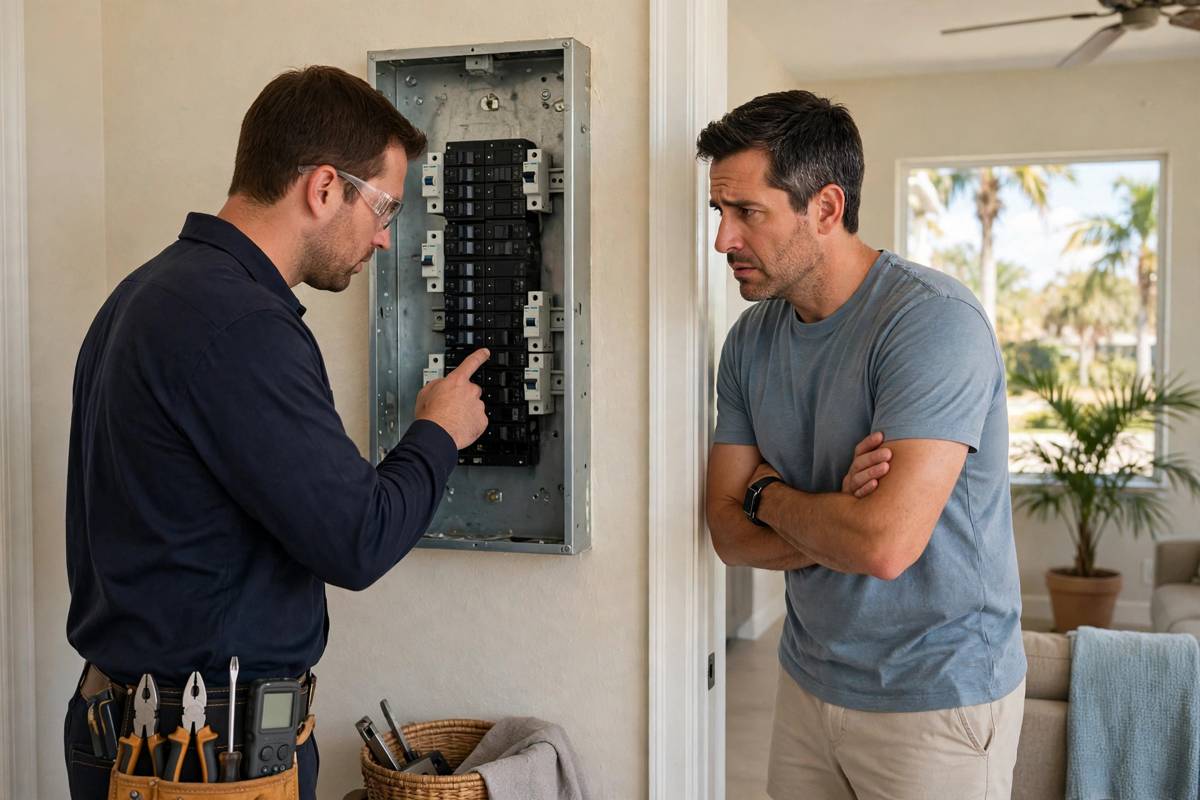
Your lights blink. Then the room goes dark. Again.
You walk to the panel, flip the switch, and pray it holds. It doesn’t.
Sound familiar? You’re not alone. Tripping breakers are one of the most common headaches in Fort Lauderdale homes.
Here in South Florida, we love to say, “the sun shines bright, but the wires feel the heat.” Our climate is tough on electrical systems. Salt air, humidity, and brutal heat all gang up on your panel.
So why does your circuit breaker keep tripping? And when is it a quick fix versus a real danger?
Let’s break it down. Plain words. No fluff.
Common Electrical Causes
Most breaker trips come from inside your home. The breaker isn’t broken. It’s doing its job.
Think of a breaker like a tiny bodyguard. When it sees danger, it shuts the door fast. That’s a good thing.
Here are the usual suspects behind the trips.
Overloaded Circuits
This is the number one cause. By far.
An overloaded circuit happens when you ask one circuit to do too much. Too many devices. Too much power. The wire heats up, and the breaker trips.
Picture a hallway built for ten people. Now shove forty through it. Chaos, right?
Common overload culprits in South Florida homes:
- Window AC units sharing a circuit with other appliances
- Space heaters and hair dryers on the same line
- Microwaves running next to toasters or coffee makers
- Power strips daisy-chained into one outlet
The fix is simple. Spread the load. Move big appliances to their own circuit.
Here’s a trick. Count what’s running before you blame the breaker. Add up the big draws on one line. You’ll often spot the problem fast.
Summer makes this worse. We crank the AC and still plug in fans. That stacks power on circuits that are already busy.
Short Circuits
A short circuit is more serious. It’s a hot wire touching a neutral wire. That sends a huge surge of current down the line.
The breaker feels it and snaps off instantly. That speed saves your home from fire.
What causes a short? Often damaged wiring. Sometimes a faulty appliance. Other times loose connections inside an outlet.
Smell something burnt near an outlet? Stop. Don’t reset the breaker. Call a pro.
A short is not a maybe-later problem. It’s a right-now problem. The current spike can heat wires in seconds. That heat is what starts fires behind your walls.
So a tripping breaker here is good news. It caught the danger first.
Ground Faults
A ground fault is a cousin of the short circuit. Here, a hot wire touches a grounded part. Think metal box or bare ground wire.
Moisture makes ground faults worse. And Florida has moisture by the bucket.
Kitchens, bathrooms, and patios see the most ground faults. Water and electricity never make good roommates.
This is why GFCI outlets matter so much. More on those soon.
Older homes often skip GFCI protection in wet spots. That’s a real gap. One splash near a bad outlet can trip the whole line. Or worse, give you a shock.
Aging or Failing Breakers
Breakers don’t last forever. They wear out. After years of heat and trips, the inside parts weaken.
An old breaker may trip for no clear reason. Or it may fail to trip when it should. Both are bad news.
Can a breaker just go bad with age? Yes. It absolutely can.
If your home is older and the panel looks tired, that’s a clue. A worn breaker is like old brakes on a car. It still works, until it doesn’t.
Lightning and Surges
Fort Lauderdale sits in the lightning capital of the country. Our summer storms are no joke.
A nearby strike sends a power spike through your wires. That surge can trip breakers in a flash. It can also fry sensitive electronics.
Even small surges from the grid add up over time. They stress your panel bit by bit.
Whole-home surge protection helps here. We’ll cover that later too.
Our grid takes a beating in storm season. Power flickers. It dips and spikes. Each little jolt wears your breakers down over months. You won’t see it happen. You’ll just notice more trips.
High Ambient and Radiant Heat
Heat is the quiet villain in this story. South Florida bakes for most of the year.
Your panel feels that heat. And heat changes how breakers behave.
Thermal Stress
Breakers trip based on heat inside the wire. That’s how they measure overload.
Now add a hot garage or a sun-baked wall. The panel starts warm before any load even hits it.
This is thermal stress. The breaker has less room to work. So it trips sooner than it should.
Many Fort Lauderdale panels live in hot spots. Garages. Exterior walls. Utility closets with poor airflow.
Think about your own panel for a second. Where does it sit? If it bakes in afternoon sun, that heat is part of your problem.
Premature Tripping
Here’s where it gets annoying. Your breaker trips even with a normal load.
Why? The outside heat pushed it over the edge. The wire wasn’t overloaded. The air around it was just too hot.
Premature tripping feels random. One day it’s fine. The next day it won’t hold.
A hot panel is a tired panel. Good airflow and shade around the panel can help a lot. Sometimes a pro will move the panel to a cooler spot.
Humidity and Salt Air Corrosion
We live by the ocean. It’s beautiful. It’s also hard on metal.
Salt air and humidity creep into everything. Your electrical panel included.
Connection Breakdown
Every wire inside your panel connects to a screw or a clamp. Over time, salt and moisture eat at those points.
The metal corrodes. The connection loosens. And a loose connection means trouble.
Loose wires spark. They heat up. They trip breakers. Worse, they can start fires.
Ever notice green or white crust on metal near the coast? That’s corrosion. Now imagine that inside your panel.
Increased Resistance
Corroded connections fight the flow of power. That fight is called resistance.
More resistance means more heat. More heat means more trips. It’s a nasty loop.
This problem is sneaky. You can’t see it from outside the panel. Only a trained eye catches it early.
And resistance builds slow. Your breaker trips a little more each month. You might blame the weather or an old appliance. But the real cause hides inside the panel wall.
Coastal homes in Fort Lauderdale face this risk the most. Salt doesn’t take days off.
Homes near the water age faster inside the panel. The ocean breeze feels nice. But it carries salt right into your wiring. Over years, it adds up to real damage.
Basic Safety and Troubleshooting Guide
Okay. Let’s get practical. Some trips you can handle yourself. Safely.
Always treat your panel with respect. If anything feels off, back away and call a pro.
Here’s your simple game plan.
Lighten the Load
Start with the easy stuff. Unplug a few things on the tripped circuit.
- Turn off power-hungry devices first
- Move the space heater or AC to another room
- Don’t run the microwave and toaster together
- Spread big appliances across different outlets
Then reset and watch. If it holds, you had an overload. Case closed.
Reset Safely
A proper reset matters. Don’t just tap the switch.
Push the breaker fully to OFF first. You’ll feel a firm click. Then push it back to ON.
Keep one hand off the panel. Stand to the side. Dry hands only.
If the breaker trips right back, stop. That’s a sign of a deeper issue.
Check the GFCIs
GFCI outlets have little buttons. Test and Reset. They protect wet areas from ground faults.
Walk your kitchen, bathrooms, garage, and patio. Look for a tripped GFCI with a popped button.
Press Reset firmly. If it clicks and stays, you’re good. If it pops right back, there’s a fault on that line.
One tripped GFCI can kill power to a whole string of outlets. So check them all.
Found the culprit? Great. You just saved a service call. But if nothing holds, don’t force it. That’s your cue to bring in a pro.
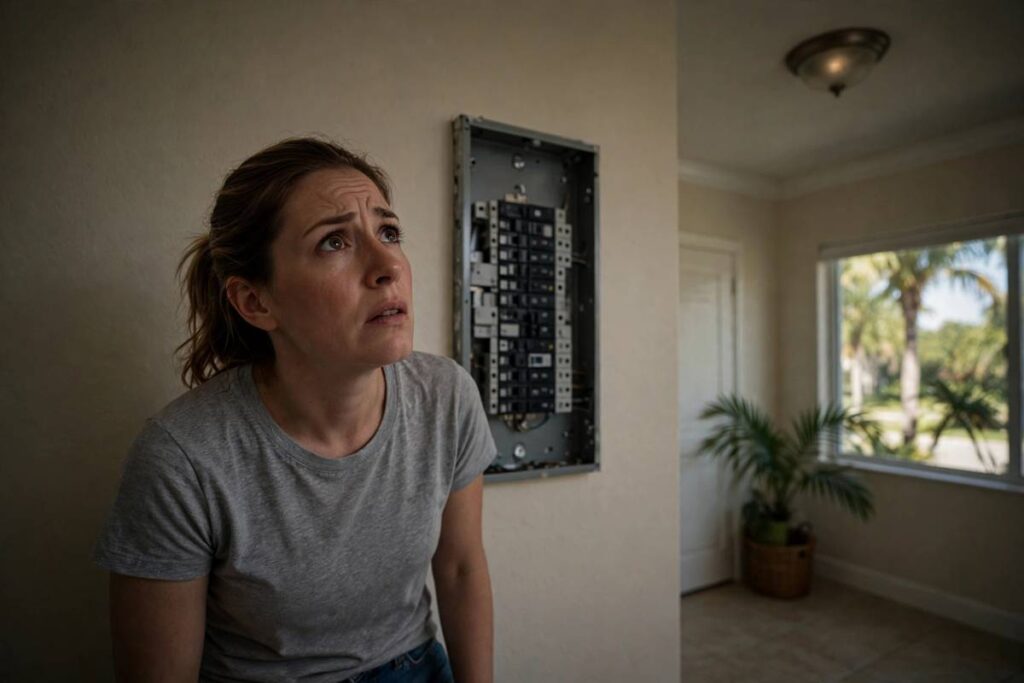
Warning Signs Your Circuit Breaker Needs Immediate Attention
Some signs are red flags. These mean stop and call for help now.
Don’t shrug these off. Your safety comes first. Always.
Burning Smell or Discolored Outlets
A burning smell near the panel is an emergency. So is a melty plastic odor.
Look for brown or black marks around outlets. That discoloration means heat damage.
If you smell burning, flip the main breaker off and call an electrician. Don’t wait. Don’t reset.
This is your home waving a bright red flag.
Buzzing or Crackling Sounds from the Panel
Your panel should be quiet. Silent, really. A soft hum at most.
Buzzing, crackling, or sizzling sounds mean danger. That noise often points to arcing. Arcing is electricity jumping where it shouldn’t.
Arcing starts fires. Fast.
Hear it? Keep your distance and get a pro out there.
Breaker Trips Immediately After Every Reset
You reset the breaker. It trips at once. You try again. Same thing.
This pattern is a clear warning. It usually means a short circuit or a ground fault.
Resetting over and over won’t fix it. It only adds risk.
When a breaker won’t hold, it’s trying to tell you something. Listen to it.
When to Call a Licensed Fort Lauderdale Electrician
Some jobs are not DIY. Not even close. Your panel carries deadly voltage.
A licensed electrician brings the right tools and training. They find the root cause fast.
At Flowtron Electric Inc., we handle these calls every day across Miami-Dade County and the Fort Lauderdale area. Here’s when to pick up the phone.
Recurring Trips Despite a Reduced Load
You lightened the load. You unplugged half the house. And it still trips.
That’s not an overload anymore. Something deeper is wrong.
Could be a failing breaker. Could be bad wiring. Could be corrosion inside the panel.
A pro traces the fault and fixes it right. No more guessing.
We bring meters and thermal tools to the job. They spot hot wires you can’t see. That’s how we find the real cause in minutes, not hours.
Visible Rust, Corrosion, or Damage on the Panel
Open your panel cover and look. See rust? See white crust? See scorch marks?
Those are not cosmetic problems. They point to real damage inside.
Coastal corrosion weakens the whole panel over time. It needs a professional eye.
Rust on a panel is like a leak on a boat. Small today, sinking tomorrow. Get it checked.
Outdated Panel Types (Fuse Boxes, Federal Pacific, Zinsco)
Some older panels are flat-out unsafe. Two names stand out: Federal Pacific and Zinsco.
These brands are known to fail. Their breakers sometimes don’t trip at all. That’s a fire risk.
Old fuse boxes are another concern. They weren’t built for modern power demands.
If you have one of these, don’t wait for trouble. A panel upgrade buys you peace of mind.
Not sure what you’ve got? Call us at (954) 945-1123 and we’ll take a look.
Long-Term Prevention and Electrical Upgrades
Fixing the trip is step one. Preventing the next one is the real win.
A few smart upgrades can save you years of stress. And keep your family safe.
Here’s how to stay ahead of the problem.
Upgrading to a Higher-Capacity Panel
Older homes often have 100-amp panels. Modern homes need more. AC units, EV chargers, and smart devices all draw power.
A higher-capacity panel gives you breathing room. Fewer overloads. Fewer trips.
Think of it like moving from a two-lane road to a highway. More room means smoother flow.
An upgrade also adds value to your home. Buyers love a strong, safe panel.
Planning an EV charger or a hot tub? You’ll need the extra capacity for sure. A right-sized panel today saves a costly redo tomorrow.
Installing Whole-Home Surge Protection
Remember those Florida storms? Whole-home surge protection is your shield.
It sits at the panel and blocks spikes before they spread. That protects every outlet in the house.
Your TV, fridge, and computer all get covered. One surge can cost thousands in ruined electronics.
For the price, surge protection is one of the smartest upgrades out there. Real relief when the sky lights up.
It also protects your AC and smart home gear. Those cost a fortune to replace. One summer storm could wipe them out in a blink. A surge device stands guard around the clock.
Scheduling Routine Electrical Inspections
Prevention beats repair every single time. A yearly inspection catches small issues early.
A pro checks for:
- Loose or corroded connections
- Worn or aging breakers
- Signs of heat damage
- Proper grounding and GFCI function
In our salty, humid climate, inspections matter even more. Corrosion works in the dark. An inspection shines a light on it.
Flowtron Electric Inc. offers inspections built for South Florida homes. We know the local climate. We know these panels.
You’ve worked hard for your home. Protect it like you mean it.
A safe panel brings a quiet kind of pride. You stop flinching when storms roll in. You stop dreading that dark room. That peace is worth every penny.
Frequently Asked Questions
1. Why does my circuit breaker keep tripping even with nothing plugged in?
If it trips with no load, the problem is inside the system. Likely a short circuit, ground fault, or a failing breaker. Corrosion from salt air can also cause it. Don’t keep resetting it. Call a licensed electrician to find the root cause.
2. Is it safe to reset a tripped breaker myself?
Yes, one reset is usually safe. Push it fully off, then back on, with dry hands. But if it trips right back, stop. A breaker that won’t hold means a deeper fault. At that point, you need a pro.
3. Can Florida heat really make my breaker trip?
It sure can. Breakers measure heat to sense overloads. A hot garage or sun-baked wall warms the panel before any load hits. That extra heat makes the breaker trip early. Shade, airflow, or a panel relocation can help.
4. How do I know if I have a dangerous Federal Pacific or Zinsco panel?
Check the brand label inside your panel cover. Federal Pacific and Zinsco panels are known fire risks. Their breakers sometimes fail to trip. If you spot either name, call an electrician. A panel upgrade is the safest move.
5. How often should I get an electrical inspection in Fort Lauderdale?
Once a year is a smart rule here. Our salt air and humidity speed up corrosion. A yearly checkup catches loose connections and worn breakers early. It’s a small cost that prevents big, costly problems.
Still fighting a breaker that won’t behave? Let the team at Flowtron Electric Inc. take it from here. Call (954) 945-1123 today. We serve Fort Lauderdale and Miami-Dade County, Florida.
